
Faruk Rahman :
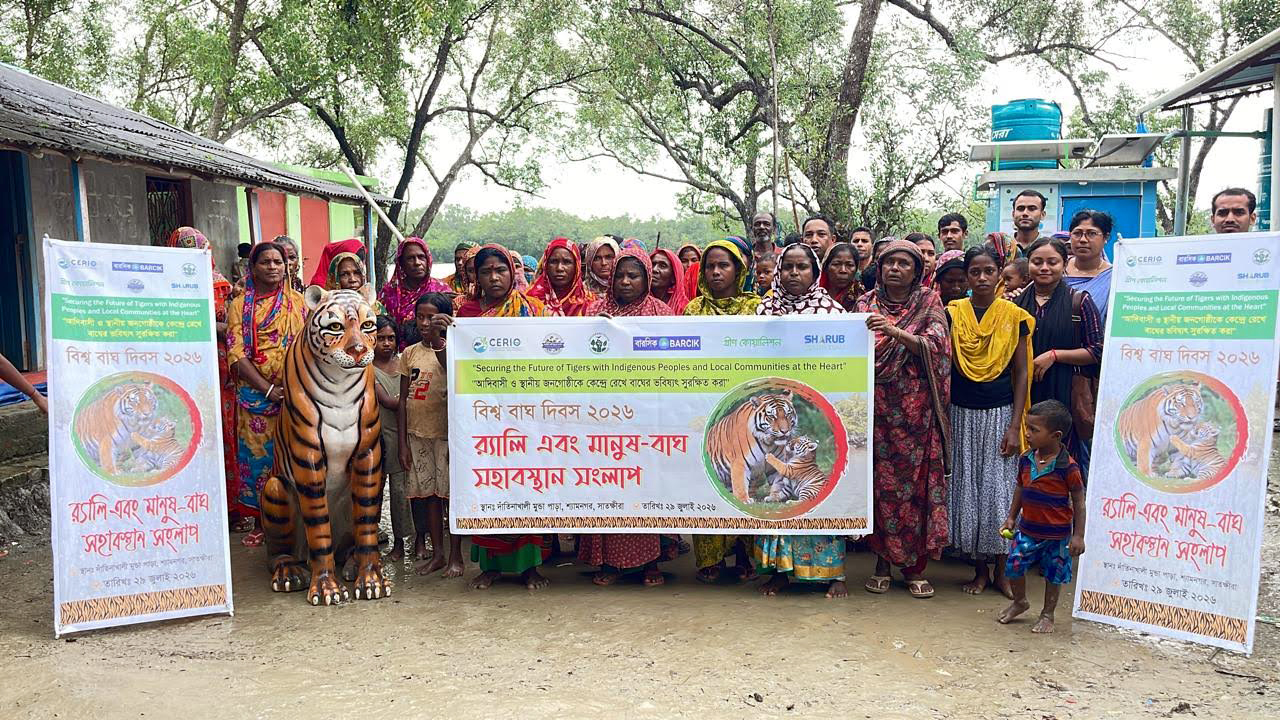
A colorful rally and “Human-Tiger Coexistence Dialogue” were held in Shyamnagar, Satkhira, on the occasion of World Tiger Day-2026, with the theme “Protecting the Future of Tigers by Keeping Indigenous Peoples and Local Communities at the Center”.
(Wednesday) at 11 am, the program was jointly organized by research institute BARSIC, Green Coalition, Dantinakhali Forestry Women Development Organization, Sundarban Youth Solidarity Team, Sirio and Sharub Youth Team at Dantinakhali Mundapara in Burigoalini Union of Shyamnagar Upazila.
The event was chaired by Shefali Begum, President of the Forest Women’s Development Organization, and moderated by Shaheen Islam, Regional Coordinator of BARSIC. The chief guest was Mustafa Zahid Hossain, In-charge of Munshiganj Forest Patrol Outpost of the Sundarbans West Forest Division.
Among others, Green Coalition member Nimai Mondal, Village Tiger Response Team member Mohabbat Ali, tribal representative Anika Rani Munda, forest men and women, environmental activists, journalists, researchers, farmers and members of various youth organizations were present.
Chief guest Mustafa Zahid Hossain said that World Tiger Day has been celebrated since 2010. The Forest Department, Village Tiger Response Team, local foresters and tribal communities, youth organizations and various non-governmental organizations are working together to conserve the tigers of the Sundarbans. Tiger conservation is not just a matter of protecting an animal; it is closely related to the biodiversity of the Sundarbans, the environment and the security of the lives and livelihoods of coastal people. Long-term success of tiger conservation is not possible without the active participation of the local community.
Village Tiger Response Team member Mohabbat Ali said, “The tigers of the Sundarbans are our national pride and one of the foundations for maintaining the balance of the environment. Therefore, along with government initiatives, responsible participation of the local people must be ensured in tiger conservation.”
Tribal representative Anika Rani Munda said, “We live next to the Sundarbans and have a long experience of coexistence with tigers. We do not fear tigers, but respect them. If the tigers survive, the Sundarbans will survive, and if the Sundarbans survive, our livelihoods will also be protected. It is necessary to give more importance to the knowledge, experience and participation of tribal and forest-dependent communities in forest management and tiger conservation activities.”
Youth organizer Shamim Hossain said, “There is no alternative to the Sundarbans in protecting the coast, and the lifeblood of the Sundarbans is the Royal Bengal Tiger. Real foresters, fishermen and farmers never harm tigers; Rather, unscrupulous poachers and trafficking rings are the biggest threat to tigers. Therefore, in addition to strict enforcement of laws to prevent tiger poaching and trafficking, local communities must be more involved in conservation activities.
Speakers at the dialogue said that climate change, deforestation, habitat loss, and human-wildlife conflict have become major challenges for the existence of tigers in the Sundarbans. To address these challenges, the traditional knowledge, experience, and leadership of indigenous and local communities must be brought into the mainstream of conservation initiatives.
At the end of the program, participants pledged to conserve the biodiversity of the Sundarbans, ensure human-tiger coexistence, and build a safe and sustainable Sundarbans for future generations.
Views: 0