Touhid Hossain Sarkar : “Minimum wages should be revised in all sectors in line with inflation.” Keeping in mind the slogan that the implementation of Islamic labor policies is inevitable to establish the rights of working people,
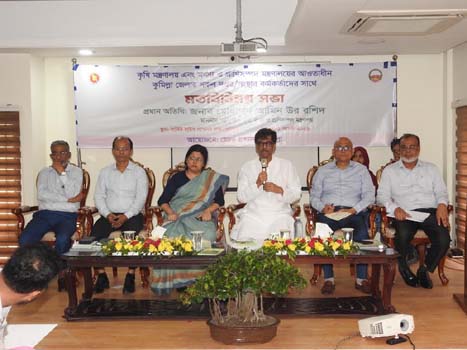
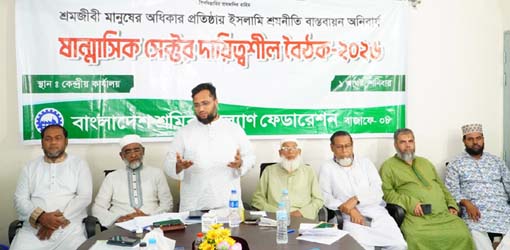
Yesterday (August 1) Saturday morning, the six-monthly sector responsible meeting was held in the hall of the central office.
The federation’s central president, Advocate Atiqur Rahman, said this in his presidential address.
Under the chairmanship of General Secretary Laskar Md. Taslim, Rickshaw Sector President Professor Harunur Rashid Khan, Agriculture and Fisheries Sector President Golam Rabbani, Transport Sector President Kabir Ahmed, Land Port Sector President Mujibur Rahman Bhuiyan, and a total of 19 sector presidents and general secretaries were present to review the report.
In his speech as the chairman, Advocate Atiqur Rahman said
We are basically a trade union federation. Our main responsibility is to protect the rights and interests of workers. But if the trade union is limited to only traditional activities and cannot play an effective role in protecting the real interests of the workers, then that organization cannot bring any welfare to the workers. The constitutional and legal right given to the workers by the state to form trade unions, the opportunity to exercise that right in reality is not being ensured.
We, who are responsible for various sectors, represent the workers. We must first understand the labor crisis and the reality. It is not possible to solve the problems of the workers by doing formal or routine work alone. What are the problems, why are they created, and how can they be solved? We must analyze these issues in depth and adopt an action plan. Only then can we truly play a role as the voice of the workers.
There are currently about fifty national trade union federations and numerous professional organizations in Bangladesh. With so many trade unions, the question of their effective role in labor issues remains. If these organizations were more vocal in favor of the workers, many problems could be solved. This is raising concerns about the future of the trade union movement.
Although the wages of workers are supposed to be determined in line with the current rise in commodity prices and inflation, in reality, this is not happening. Although some workers in state-owned enterprises receive benefits, a large number of informal workers in the country are still deprived of the minimum wage. As a result, they are not assured of an income commensurate with the cost of living. We must be vocal in demanding the implementation of fair wages and minimum wages in every sector in which we work.
The eight-hour working day has not yet been implemented in various sectors. About 90 percent of the workers in the transport sector work up to 15 hours a day. In such a situation, it is unfair to blame only the workers if an accident occurs. They do not have a weekly holiday, they do not have the opportunity to spend time with their families. A worker is forced to work extra hours without giving him the minimum opportunity to be mentally refreshed. This is also a failure of the state.
In Bangladesh, whenever an accident occurs, there is a tendency to blame the worker alone. We protest against this. The driver alone cannot be responsible for a road accident. If the vehicle is not fit for purpose, the owner is responsible, if there is a defect in the road, the concerned authority is responsible, and if there is a failure in traffic management, they too must be held accountable. Similarly, it must be ensured that the rights and protections stipulated for workers in the labor law and related regulations are actually being provided to them. The weaknesses in the implementation of the law must be identified and initiatives must be taken to implement them.
Most of the country’s workers are still deprived of a safe working environment. It is very important to ensure the safety of women workers, construction workers, and workers working in risky sectors. Workers work at risk for the needs of the state. But when an accident occurs, they do not even get the compensation they deserve. Not getting compensation is one of the biggest crises of workers. Trade union organizations should be given priority and a movement should be built.
About 85 percent of the country’s workers work in the informal sector. A large number of workers, including construction workers, hotel workers, agricultural workers, and transport workers, do not receive any pension, rationing, or social security benefits after losing their ability to work. This is not consistent with a humane state. The state must take responsibility for those who have worked all their lives to keep the state’s economy running in their old age. It is the state’s responsibility to ensure pension, rationing, and social security for them when they lose their ability to work.
We cannot just stand by and watch these realities. We must build a social movement to establish the rights of workers. Those who form trade unions, where there can be no compromise on injustice and oppression. Compromise must be forever banished from the chapter of trade union politics.
We have an important opportunity now. We do not oppress, nor will we tolerate oppression. The hadith of the Holy Prophet (PBUH) teaches us to protest against oppression. Today is not just the time to hate in our hearts; it is time to build organized resistance against injustice and oppression.
Calling on the government, he said that a minimum wage should be set for workers of all professions in the country that is commensurate with the cost of living. Special arrangements for pension, rationing, medical treatment and education of children should be ensured for informal workers. A safe, decent and dignified working environment should be ensured for female workers. Sustainable development is possible only if proper protection and social status are ensured for more than half of the country’s female workforce.
We, the workers of Bangladesh Workers’ Welfare Federation, can proudly say—”We are the voice of the oppressed workers.” It is our commitment to work sincerely for the welfare of ordinary workers. Taking this opportunity as a deposit, we will continue to work relentlessly to establish the rights of workers, build a just society, and establish a successful state.
Views: 1