
Mohammad Masud Majumder:
The Bangladesh Passenger Welfare Association has demanded an immediate stop to such fare hikes, alleging that the influential bus and launch owners’ association is violating the international consumer rights law and has demanded that such fare hikes be stopped.
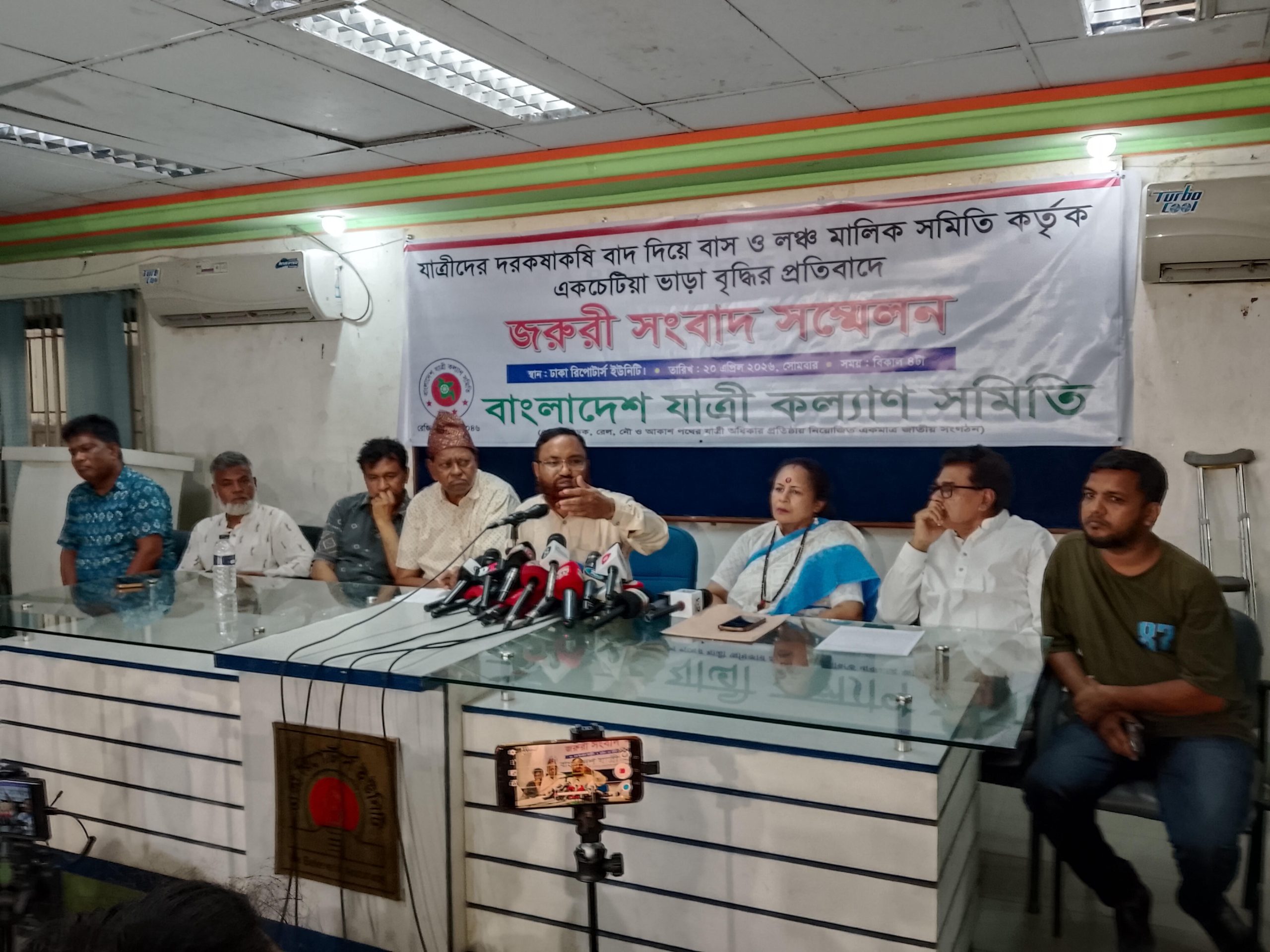
On the afternoon of April 20, at Dhaka Reporters Unity, Bangladesh Passenger Welfare Association Secretary General Md. Mozammel Haque Chowdhury made such allegations at an emergency press conference called “in protest against the monopolistic fare hikes by the bus and launch owners’ association, ignoring the bargaining of passengers.”
He said that it is natural that if the price of fuel increases, the fares of buses, launches and other public transport will increase proportionally. But the Bus and Launch Owners Association is trying to fix the fare exclusively by managing some government officials without representing or negotiating the passengers. Why should the determination of the public interest be hidden? Why should it be hidden from the media? Passengers are subjected to fights in buses and launches over the extra fare, passengers are humiliated, but in paying this fare, the affected party is protesting against the attempt to fix the fare exclusively without representing the passengers. We, the passengers of the country, have raised the following important public grievances to attract the attention of the government.
1. Although the fare of a 52-seater bus is fixed, no 52-seater bus fare list is prepared. In the name of comfort, fares are collected for 52-seater, 55-seater, and 60-seater buses in the 40-seater fare list. Which is tantamount to cheating the passengers.
2. In the cost analysis of determining the fare of the bus, 21 factors are brought to the liking of the owners. No government or private or aggrieved party or third party is given the opportunity to verify the mentioned elements. As a result, there is an opportunity to determine exclusive fares.
3. The dilapidated buses of Dhaka and Chittagong metropolis are presented on the fare determination table by showing abnormal prices and abnormal bank interest, and the price is increased, resulting in an increase in the fare.
4. The old dilapidated buses stop here and there while running with passengers, creating passenger distress. However, these buses are charged abnormal prices for routine maintenance, tires, tubes, etc. parts.
5. The salaries of the driver, assistant, and 3 staff who collect the fare are determined on the fare and the fare is increased. However, no driver, assistant, or fare collector is given any kind of salary bonus in any bus in this city. They run buses on contract, which is one of the traps for cheating in increasing the fare.
6. No bus plying in Dhaka-Chittagong metropolis has comprehensive insurance, yet the fare is increased exclusively by showing comprehensive insurance, minor accident risk, garage space as abnormal.
7. After the fare increase, the fare list is prepared at the discretion of the owners, stoppages are determined according to the convenience of the owners, distance or kilometer deductions are made, etc. Although there are traps to cheat passengers at every step, there is no one to see these frauds because the government has not included representatives of the general public.
8. Although the fare is fixed as a kilometer in long-distance buses, even if the passenger travels a short distance, the fare for the final destination is collected.
9. Although separate fare rates have been set for CNG-powered buses and diesel-powered buses, fares are collected at increased rates in both buses. Since the monitoring system is under the control of the owners, there is no one to see if passengers are victims of such fraud.
10. Although the drivers, assistants, and fare collectors increase the fare by imposing two Eid bonuses on the fare every year during Eid, the practice of paying salary bonuses is not in place, but the anarchy of collecting additional fares on Eid is growing every year. Since the monitoring system during the Eid journey is controlled by the owners, this anarchy is increasing to the extreme every year.
11. In different areas of the country, one fare in the morning, another fare in the afternoon, another fare in the evening, different fares on rainy days, new fares on Thursday afternoon, another fare before and after Eid, such anarchy is suffered by people all over the country every day, but since the representation of the general public of passengers is not ensured in the government forum, and the Road Transport Act is a law controlled by the Owners’ Association, the problems of millions of victims in the country are increasing day by day. However, bus and launch owners are managing the government and pushing the monopoly fare on the shoulders of these suffering common people, which they claim is absolute oppression.
12. The front door of every 50/52 and 60 seater city service bus is the main cause of passenger suffering and road safety. Broken doors and windows of these buses, passengers stranded in the bitter cold, passengers soaked in rainwater on broken roofs, passengers getting on and off in moving buses at random, passengers being dropped off in the middle of the road at the risk of their lives, bus shortage on important routes, bus congestion on unnecessary routes, buses diverting half the route as the driver wishes without complying with the conditions of the route permit, and buses running on profitable parts of the route. Who will solve the problem of harassment of thousands of passengers? They are also in the Owners’ Association and Workers’ Federation Monitoring Committee in every government committee, and the leaders of the Owners’ Association are around the minister. Who will see to these problems of passenger misery and fare anarchy? Ministers always speak for the owners because they are surrounded by the owners’ association, which further exposes the anarchy on the roads. Can’t we say this in the fare determination table as well?
Recently, in the wake of the three-point reduction in the price of fuel oil, bus fares have been reduced by 1 paisa for every 1 taka. Based on the same formula, this time due to the increase in the price of 1 taka per liter, bus fares can be increased by a maximum of 15 paisa per kilometer. If it is different, the Passenger Welfare Association will be prevented from going on a tough and tough movement. He sought the intervention of the Honorable Minister of Road Transport and the Honorable Prime Minister to resolve these issues.
Consumer Association of Bangladesh (CAB) General Secretary Advocate Humayun Kabir Bhuiyan, Organizing Secretary Abul Kalam Azad, Mahmudul Hasan Russell, Alamgir Kabir Bitu, Manjur Hossain Isa, among others, also spoke at the event.
Views: 5