
Moshtaq Ahmad :
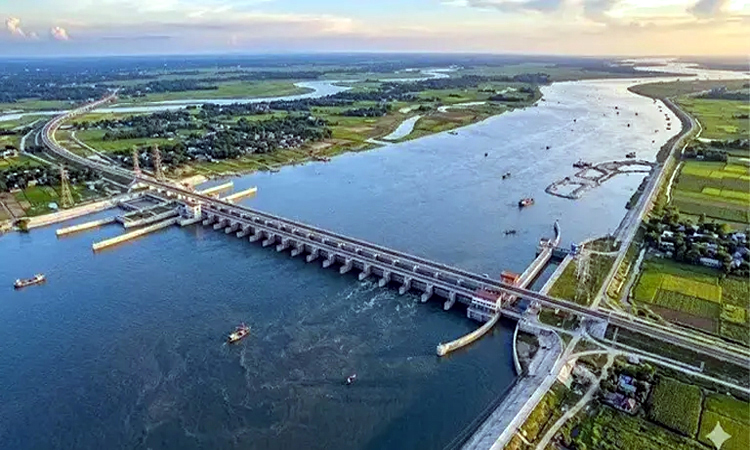
The Padma Barrage project has now joined the long-awaited journey of development in the southwestern region of the country. If this project is implemented, the landscape of 24 districts will change in terms of agricultural production, employment generation and regional economy. Those concerned are expecting major changes in river management, environment and people’s livelihood.
In this regard, State Minister for Water Resources Farhad Hossain Azad told BSS that the Padma Barrage is not just a river-centric project, it is also associated with the lives and livelihoods of crores of people in the southwestern region of the country. Due to the long-standing navigability crisis and limited management, its full potential could not be utilized.
He said that through the implementation of the project, effective changes will be made in river management, water conservation, expansion of irrigation facilities, prevention of river erosion and flood control.
The State Minister said that if this project is implemented, agricultural production of 5 crore people in 161 upazilas of 24 districts will increase, employment will be created and positive changes will come in the regional economy. Its benefits will reach the people of the whole country directly and indirectly.
The Padma Barrage Project is emerging as a new hope to address the challenges of river erosion, dry season irrigation crisis and regional inequality. According to experts, if the project is fully developed and expanded, it will directly and indirectly bring about major changes in the country’s economy, agricultural production, employment, environment and people’s livelihood.
According to agricultural experts, the implementation of the project can transform more than 200,000 hectares of single-crop land into two-crop land and more than 100,000 hectares into three-crop land. Fresh water will reach farmers instead of salty sea water, which will increase the fertility of agricultural land and bring a great revolution in food production. This will create opportunities to produce several million additional tons of food grains annually.
Currently, the average production of Boro rice in the southwestern region is 4.5 to 5 tons per hectare. Agricultural researchers believe that it is possible to increase it to 6 to 7 tons through uninterrupted irrigation and the use of modern technology.
Similarly, wheat production per hectare can increase from 3.5 tons to 4.5 tons, corn production from 8 tons to 10-12 tons and potato production from 25 tons to 30-35 tons.
Ali Newaz Mahmud Khayyam, MP from Goalanda in Rajbari, a district on the banks of the Padma, and the government’s State Minister for Culture, told BSS that the people of the banks of the Padma are committed to the implementation of the Padma Barrage Project. They are eagerly waiting to get the benefits of this project.
He said that the people of 24 districts in the southwestern region of the country, including Rajbari, are particularly grateful to the Prime Minister and BNP Chairman Tarique Rahman. Because without the Prime Minister’s sincerity, this project would never have been passed. The project has already been passed by the ECNEC. For this, he also expressed his gratitude to the Prime Minister.
The State Minister for Culture said that the Padma Barrage Project is no longer a dream but a visible reality in the country’s river management and agricultural production.
Water resources experts believe that the implementation of the Padma Barrage Project could create new possibilities for controlling river erosion and flooding in the southwestern part of the country.
Thousands of families have been affected by river erosion, flash floods and changes in the course of the river in the districts along the Padma for a long time. Those concerned hope that if a modern river management plan is implemented under the project, it will be possible to significantly reduce this damage.
The government has approved the Padma Barrage Project at a cost of about 34,497 crore taka to alleviate the water crisis in the southwestern part of Bangladesh and revive the dying rivers. The goal of completing this mega project, which is being implemented entirely with its own funding, has been set to be completed by June 2033.
According to experts, the livelihood of about 3 million to 4 million people in the project area will benefit directly and indirectly due to the increase in agricultural production. Farmers’ income can increase by an average of 25 to 40 percent. In addition, new jobs will be created in the transportation, storage, processing and marketing sectors of agricultural products.
According to the Water Development Board, the length of the Bangladesh part of the Padma River is about 341 kilometers. Of this, several hundred hectares of agricultural land are lost to the riverbed every year due to river erosion in different places. In the last two decades, an estimated 8 to 10 thousand hectares of agricultural land have been affected by river erosion in different areas along the Padma River.
An average of 10 to 15 thousand families are directly at risk of river erosion every year in the districts along the Padma River. In many cases, homes, educational institutions, rural roads and cropland are lost to the riverbed. This has a huge negative impact on the local economy.
According to experts, if regular dredging activities, construction of bank protection dams and river flow management are ensured under the project to protect the navigability of the river, it may be possible to reduce the rate of river erosion by 30 to 50 percent. Especially in risky areas, thousands of hectares of agricultural land will be protected by constructing geobags, concrete blocks and permanent defense infrastructure.
Water resources experts say that the new plan, which includes additional water storage, controlled water flow, and rapid drainage, will significantly reduce the severity of floods. It is estimated that the risk of flash floods could be reduced by 20 to 30 percent if the water holding capacity of the river is increased.
In addition, through the development of river management, it may be possible to protect about 2 to 2.5 million people from the risk of floods and river erosion. At the same time, agricultural production, roads, bridges, educational institutions and homes worth thousands of crores of taka will be saved.
Economists and development analysts believe that the implementation of the Padma Barrage Project will not only increase agricultural production in the southwestern region, but will also have a huge positive impact on employment and the rural economy.
According to them, this mega project can create millions of new employment opportunities in the agriculture, industry, transportation, marketing and service sectors.
Experts say that the expansion of the irrigation system will also increase new investments in agricultural machinery, seeds, fertilizers, pesticides, agricultural product transportation and marketing sectors. As agricultural production increases, the demand for warehousing, cold storage and food processing industries will also increase. As a result, there is a possibility of more than 1,000 small and medium agro-based industries being established in the southwestern region.
According to the Bangladesh Bureau of Statistics (BBS) and economic analysts, an average of 20 to 30 jobs are created for every 1 crore taka investment in agro-based industries. Accordingly, investment in project-related areas can create one to two lakh additional jobs in the long run.
According to experts, the increase in agricultural production will also increase the flow of money to the local market. About 3 million to 4 million people in the project area can directly and indirectly benefit economically. In addition, there is a possibility of an average increase in farmers’ income by 25 to 40 percent. This will give a new impetus to the rural economy and play a positive role in poverty reduction.
Source : BSS
Views: 2