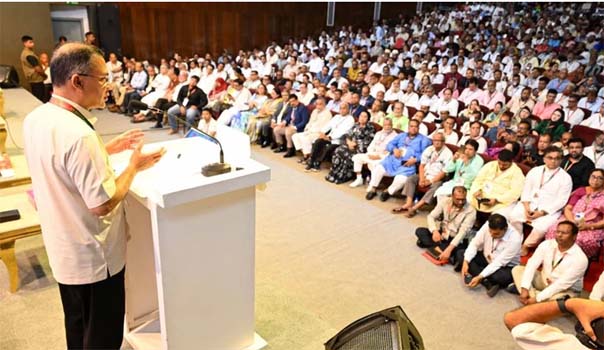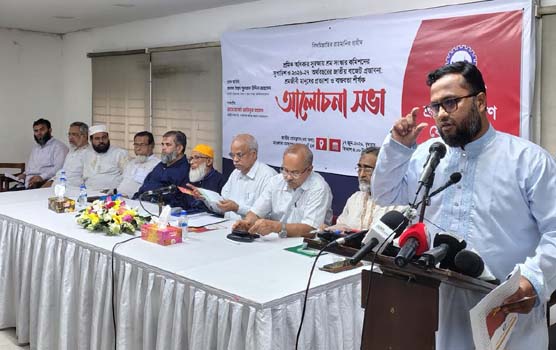

Towhid Hossain Sarkar : Recommendations of the Labor Reform Commission for the protection of workers’ rights and the national budget proposal for the fiscal year 2026-27, expectations and reality of the working people at the discussion meeting titled “Recommendations of the Labor Reform Commission for the protection of workers’ rights and the national budget proposal for the fiscal year 2026-27, expectations and reality of the working people”
Bangladesh Workers’ Welfare Federation Central President Advocate Atiqur Rahman said in his speech, “We saw that the Labor Reform Commission went to various labor organizations in the country before the elections, accepted their statements and worked to include the issue of workers’ rights in the election manifesto of each political party. As a result, almost all political parties have included the issue of workers’ rights in their manifestos.
He said, the Bangladesh Workers’ Welfare Federation organized a discussion meeting on workers’ budget ideas at the National Press Club on May 18. Later, on May 24, we presented the worker-friendly budget proposal at the same place. Our proposals have been published with importance in various national dailies and media, and many newspapers have also published supplements on this issue.
Advocate Atiqur Rahman said, we had given about 30 recommendations to the government to give priority to workers. Among these, the budget mentioned the preparation of a digital database of workers, the launch of bus services for women workers, and bringing 1.5 million fishermen families under the VGF benefit. In addition, an allocation of Tk 1.33 trillion was also mentioned for the social infrastructure and security sector.
However, other important issues such as changing the fate of workers, eliminating discrimination, and ensuring their social security were not properly reflected in the budget. A review of the budgets of the past 10 years shows that this budget is relatively lagging behind in terms of allocation to the labor sector.
He said, about 2 million new workers are joining the labor market every year. As a result, about 20 million workers have been added in the last 10 years. However, 10 years ago, the allocation to the labor sector was 0.006 percent of the total budget, which has now decreased to 0.004 percent. This budget will in no way help achieve that goal of a discrimination-free Bangladesh that we expect.
He further said, this budget was not formulated keeping in mind the reality and needs of the workers of Bangladesh. Those who formulate the budget sitting in air-conditioned rooms do not have the participation of any worker representatives. As a result, it has become not worker-friendly, but an elite-friendly budget.
He told the members of parliament and ministers, you became MPs and ministers with the votes of the workers. Therefore, you have to be vocal on behalf of the workers. If you do not speak on behalf of the workers, then we will be forced to say – you have not been able to be a worker-friendly public representative.
Calling on the government, he said, we hope the government will seriously consider our reasonable demands. We had demanded at least 10 percent allocation for the labor sector in the national budget. Along with this, we had also proposed the formation of a wage protection fund, the introduction of occupational insurance and ensuring an effective social security system for the workers. But we did not see the reflection of these demands in this year’s budget.
We said we would not pay indirect taxes, but the government did not keep this promise. The budget has been prepared to kill the poor through indirect taxes.
We hope that there is time, including ration system for workers, dearness allowance system, reduction of indirect taxes, affordable housing project for workers, wage protection fund, health insurance, risk allowance, and occupational insurance. We want to see the current government believe in deeds, not words.
In his speech as the chief guest, Syed Sultan Uddin Ahmed, head of the Labor Reform Commission, said, “It is not possible to establish a non-discriminatory and just society in Bangladesh unless the national minimum wage is determined and unemployed, retired, and elderly workers are included under the social security system. I think that the safety and dignity of workers cannot be ensured without giving importance to these issues.
He said, there is extensive discussion and planning about the pay scale of government employees. But there is very little discussion about the standard of living, wages, and social security of the large working population outside the government system. This inequality must be eliminated.
He praised the initiative of the Bangladesh Workers’ Welfare Federation and said, “Their budget idea has taken into account the overall reality of the country and the needs of the working people. The proposals they have made considering the context of the country are very timely.” Syed Sultan Uddin Ahmed said that a budget that is formulated without taking into account the challenges of the future will hinder the progress of the country. Effective preventive measures must be taken by identifying the obstacles in the way of implementing development programs. At the same time, the challenges of budget implementation must also be clearly defined. He further said, “Most of the issues that we raised with the Labor Reform Commission have been reflected very well in the budget idea of the Bangladesh Workers’ Welfare Federation.” Regarding the protection of workers’ wages, he said, “An entrepreneur rents a house to run a business, purchases machinery and raw materials, and pays other expenses in advance. But wages are paid at the end of the month after accepting the labor of the worker. Considering this reality, we have proposed to reserve at least three months’ worth of wages in advance to protect the wages of the workers. Through this, it will be possible to ensure the employment and income security of the workers.’
He stressed the importance of implementing fair wages, social security and labor protection policies to build a worker-friendly state.
The meeting will be moderated by Central General Secretary Laskar Md. Taslim,
Special guest Hibebe was present,
Central Vice President and President of Bangladesh Rickshaw-Van Sramik Oikya Parishad
Professor Harunur Rashid, Labor Reform Commission Member AM Faiz Ahmed,
Labor Federation General Secretary Shakil Akhtar Chowdhury,
Agricultural Workers Union President Golam Rabbani,
Transport Workers Federation President Kabir Ahmed,
Darji Sramik Federation President Advocate Alamgir Hossain,
Hotel and Hospital Workers Sector President Abdus Salam,
Rickshaw Van Sramik Oikya Federation General Secretary Maulana Mohibullah,
Bangladesh Bank Employees Association President Azharul Islam,
Bangladesh Progressive Construction Workers President Nuzrul Amin, Bangladesh Progressive Garments Workers Federation President Sohel Rana Mithu,
Railway Employees League Vice President Omar Farooq,
BTCL Adarsh Sramik Union President Nurul Islam, DPDC President ANM Bazlur Rahman, DESCO Outsourcing President Abul Hossain, and shipping worker leader Osman Gani were among others.
Views: 6