
Mohammad Masud Majumdar:
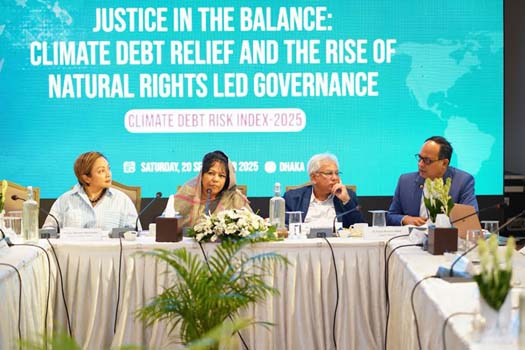
Dhaka, 20 September 2025: According to the ‘Climate Debt Risk Index (CDRI-2025)’ published by the Change Initiative, Bangladesh ranks at the top of the list of countries most at risk from climate change due to its debt burden. Although Bangladesh is responsible for only 0.5 percent of global carbon emissions, Bangladesh’s current per capita climate debt stands at US$79.6, one of the highest among least developed countries. Bangladesh’s debt-to-grant ratio (2.7) is almost four times that of least developed countries (LDCs) (0.7). In addition, the ratio of loans received from multilateral development banks (MDBs) is 0.94, which is almost five times higher than the global average of 0.19. The index also shows that Bangladesh’s climate adaptation and mitigation investment ratio is only 0.42, less than half the average ratio for least developed countries. As a result, efforts to achieve climate resilience are severely underfunded. The study was conducted by M. Zakir Hossain Khan, CEO of Change Initiative; the results were presented by co-researcher Tanmoy Saha.
The study reveals how the international climate finance mechanism, promised as a ‘compensation’ for the Paris Agreement, has become a “climate debt trap” for vulnerable countries. More than 70 percent of climate finance comes in the form of loans, which is causing a double whammy for vulnerable countries: first, countries are increasingly affected by climate-induced disasters. At the same time, they are suffering a second set of losses through the increasing debt repayments. Between 2000 and 2023, more than 130 million people in Bangladesh were displaced or affected by climate-related disasters, and the economic losses amounted to US$13.6 billion. Despite all this, support for climate adaptation is negligible. On the other hand, households in the country are forced to spend an average of 10,700 taka (about 88 USD) per capita per year on self-financing protection measures against climate-induced disasters, which amounts to 1.7 billion USD annually at the national level.
Bangladesh’s picture
• Per capita climate debt: $79.6, the highest among LDCs and almost 4 times the average debt of LDCs.
• Loans vs. grants: Loan-grant ratio 2.7, while the average for LDCs is only 0.7.
• Multilateral climate debt: The loan-grant ratio of climate finance from the Multilateral Climate Fund is 0.94, almost five times the LDC average (0.19).
• Neglect in the adaptation sector: The adaptation-mitigation ratio is only 0.42, less than half the LDC average (0.88).
• Clear violation of the ‘polluter pays principle’ principle: Bangladesh is being forced to borrow $29.52 for every ton of carbon dioxide emitted.
• Sector-specific debt trap: More than half of climate finance is used in the energy sector, which is largely debt-based (energy sector debt-grant ratio 11.99:1). Transport and warehousing sector financing is almost entirely debt-based (debt-grant ratio 1123:1). The water supply sector, despite being crucial for adaptation, has a debt ratio of 7.78:1. On the other hand, agriculture, disaster preparedness, health and industry sectors have received severely underfunded funding relative to risks and needs.
• Fraud in the name of financing: 18.84% of the reported “climate” finance for Bangladesh has been misallocated to fossil fuel projects. These projects have a debt-grant ratio of 28.8, which is increasing Bangladesh’s overall debt and hindering real climate solutions.
Key messages
• Bangladesh’s climate finance system is debt-based, slow and incompatible with life-saving adaptation activities.
• The public is forced to adapt to climate change at its own expense as government funding is delayed and comes in the form of loans.
• The debt burden is increasing and credibility is being undermined by the portrayal of climate finance in fossil fuel projects.
• Without urgent corrective measures, the country’s fiscal capacity will be squeezed, spending on the social sector will be reduced, and the impact of climate-related disasters will be more severe.
• Grant-based financing and transparent classification are essential to avoid the growing debt trap.
•
A fair climate finance path (Natural Rights-Based Governance)
Bangladesh is showing a realistic path based on ‘Natural Rights-Based Governance (NRLG).’ This governance recognizes the inherent right of people and nature to survive, restore, and thrive, and considers climate finance as an obligation rather than a gift. Under this system, assistance for adaptation and loss and damage must be debt-free. Its availability at the local level must be ensured and there must be transparent rules to prevent misallocation.
Immediate Actions:
• Grant-based financing: At least 70% of the adaptation sector and 100% of the Loss and Damage sector should come as grants. Loans should be accepted only where economically viable and fair, with easy terms.
• Debt forgiveness and swaps: Climate-related debt should be canceled and debt-for-nature/climate swaps should be increased.
• Direct local financing: Municipalities, local governments and communities should be provided with direct financing through simplified processes and transparency and accountability should be ensured at the sub-national level.
• MDB reform: Increase grants, rebalance the adaptation sector, end misallocation to fossil fuels and support local platforms for long-term change.
• Earth Solidarity Fund: Establish a global grant mechanism through carbon pricing and transaction taxes, which will unconditionally finance domestically owned climate resilience projects.
• National Reform: Transform the Bangladesh Climate Change Trust Fund into the ‘Bangladesh Natural Rights Fund (BNRF)’, which will ensure rights-based allocation and community participation. It will also include new domestic sources such as pollution taxes and carbon pricing.
Global picture
The CDRI-2025 index includes 55 countries. It shows that 13 countries are at very high risk, 34 countries are at high risk, and 8 countries are at medium/low risk. More than 70% of climate finance in all LDCs comes in the form of debt, which is a direct violation of the ‘Polluters Pay Principal’ principle of the Paris Agreement and the 2025 International Court of Justice (ICJ) ruling on climate compensation. The full international version of this index, with comparative figures across countries, will be released at the COP-30 conference.
Keynote Speakers:
Dr. Farhina Ahmed, Secretary, Ministry of Environment, Forest and Climate Change
“Conserving biodiversity reduces the impact of climate change, but the tangible results at global forums like the COP are few—and people are at risk. Bangladesh needs to respond to the issue of uneven carbon emissions mentioned in the International Court of Justice (ICJ) ruling and prioritize public-private initiatives, national adaptation plans and implementation of NDCs.”
Dr. A. K. Enamul Haque, Director General, BIDS
“Climate science, yet Bangladesh is deeply at risk. Grants are limited, debt risks are high, and overreliance on the private sector increases financial pressure. Vulnerable communities also face threats like human trafficking. Sustainable energy requires local knowledge, technology, and system-change—piecemeal solutions are not enough.”
M. Zakir Hossain Khan, CEO, Change Initiative
“Without strong commitment and clear governance, the $1 billion ‘Climate Finance Action Fund’ announced at COP-29 will remain a lofty goal; it will not become a real lifeline for vulnerable countries.”
Nyoka Martinez-Backstrom, First Secretary and Deputy Head of Development Cooperation, Embassy of Sweden, Dhaka
“Climate finance must be accountable, fair and effective—to protect resources and ensure a just transition. New sources beyond grants are needed. The ‘Climate Vulnerability Index’ and inclusive budgeting can guide allocation, but the most important thing is real impact on communities. Projects that truly advance adaptation and mitigation—such as public transport—should be prioritized.”
Dr. Fazle Rabbi Sadek Ahmed, Deputy Managing Director, PKSF
“Unless adaptation finance is grant-based and equitable, the world could fall into a climate debt crisis—where the survival of vulnerable people becomes costly and ultimately the stability of all is threatened.”
Shirin Lira, Cooperation Officer, Embassy of Switzerland
“If Bangladesh cannot ensure accountability, transparency and good governance—and the money does not reach the most vulnerable people—then it will be difficult to access global financing. It is not just policy; local people are the first responders to disasters. International commitments will not bear fruit on the ground unless their capacity is built.”
Faria Hossain Iqra, Greenspeaker, Greenpeace Southeast Asia
“As Bangladesh prepares to graduate from LDC; access to equitable climate finance will be even harder. We need to explore how the ICJ advisory opinion can be a legal tool to hold large emitters accountable and get the support they deserve.”
Dr. Simon Parvez, Special Assistant to the BNP Chairperson
“Bangladesh has low emissions, high impact. Climate finance must move away from debt-dependence to equity and equity—with transparency, accountability, and real adaptation support. Nature-based solutions, waterway restoration, renewable energy, climate-smart agriculture—all of these require expertise, national commitment, and global solidarity. Let the era of climate debt end, and the era of climate justice begin.”
Dr. Kazi Shahjahan, Joint Secretary, Economic Relations Division (ERD)
“Climate science is intertwined with politics, economics and human behavior. Effective financing requires understanding national and international policies, learning from global development frameworks and building local capacity to strategically use information resources.”
Views: 9