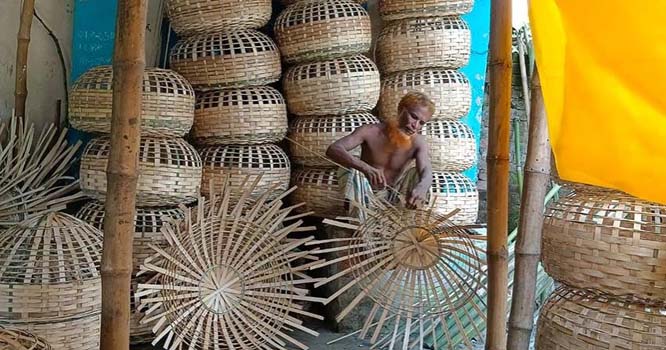

Dinajpur Correspondent: Once upon a time, bamboo hand fans, kula, dali, baskets, fishing rods, sieves and various household items were a daily occurrence in every house in rural villages. With the changing times, that scene is now a thing of the past. Due to the easy availability of plastic products, rising prices of raw materials, increased production costs and lack of adequate markets, the traditional bamboo industry of Dinajpur is in crisis today. Many craftsmen are forced to leave their ancestral professions and search for alternative livelihoods due to not getting a fair price.
Recently, a visit to the traditional Setabganj Hat in Bochaganj Upazila of Dinajpur showed that the number of shops and buyers of bamboo products has significantly decreased compared to before. Various products made of plastic now dominate the market. As a result, the demand for eco-friendly products made of bamboo is decreasing day by day.
The artisans said that even a few years ago, there was a good demand for bamboo kula, dali, basket, hand fan, sieve and fishing equipment. Currently, the price of bamboo has increased several times, so the production cost has also increased. On the other hand, the proper price of labor is not being paid. As a result, they are struggling to cover the production cost.
Biplob Pal, an artisan associated with the bamboo industry for about 40 years, said, “Earlier, this work used to cover all the expenses of the family. Now, there is no sales like before. The new generation is also not interested in this profession. They are moving to other professions.”
Mahesh Chandra Roy and veteran artisan Anil Pal, who have been in this profession for about 30 years, shared the same experience. They said that they are not doing this work in the hope of profit; rather, they are still doing it to maintain the family tradition. Artisan Nikhil Sarkar said, “Due to lack of money, the eldest son had to be sent to another profession. It is no longer possible to run the family by working only with bamboo.”
However, despite the adversity, some innovative artisans are showing new horizons of potential. One of them is Shafiqul Islam. He is trying to increase the interest of buyers by making bamboo products with modern designs, attractive colors and new designs.
Shafiqul Islam said, “People’s tastes have changed. So, we are making new design products in line with the times. Sales have increased slightly compared to before and we are also making profits.”
Young entrepreneur Arif Hossain said, “Bamboo industry is not just a cottage industry, it is part of Bengal’s tradition and culture. If government sponsorship, modern designs, online marketing and markets can be created at home and abroad, this industry can become a promising sector again.”
According to local artisans, modern training of artisans, easy-to-use loans, market expansion of manufactured products, priority for domestic environmentally friendly products in government procurement policies and planned encouragement of commercial bamboo cultivation are necessary to sustain the bamboo industry.
In this regard, Bangladesh Small and Cottage Industries Corporation (BSCIC), Dinajpur Deputy General Manager Md. Jahedul Islam said, “There is no alternative to modernizing the bamboo industry. Three-month training, entrepreneurship development, loan assistance and regular consultation are being provided to improve the skills of artisans through BSCIC. We are ready to provide necessary assistance to interested entrepreneurs.”
When the world is emphasizing the use of eco-friendly products as an alternative to plastic to reduce environmental pollution, it is the demand of the hour to preserve the country’s traditional bamboo industry. According to those concerned, if effective government initiatives, easy financing, modern marketing systems and public awareness are implemented, this almost extinct bamboo industry of Dinajpur can open the door to new possibilities again. Otherwise, this century-old tradition will someday be confined to the pages of history.
Views: 1