
Special Correspondent: Professor Muhammad Yunus, Chief Advisor to the interim government, has called for the early commencement of negotiations on a free trade agreement (FTA) with the European Union (EU).
He said, “It is essential to prepare now so that Bangladesh’s exports—especially ready-made garments—have continued access to the EU market even after the expiry of the existing duty-free facilities.”
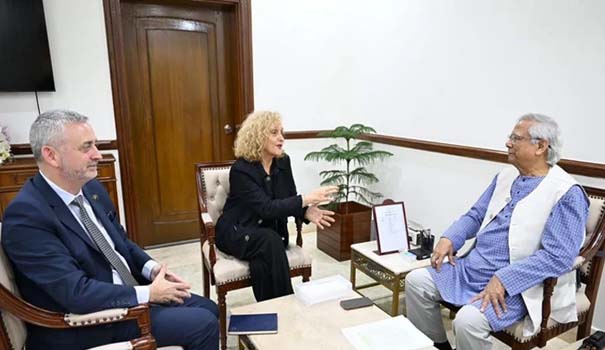
Nuria Lopez, Chairperson of the European Chamber of Commerce in Bangladesh (EuroChem), made these remarks at the Jamuna State Guest House in Dhaka on Sunday when she paid a courtesy call on the Chief Advisor. The meeting was also attended by European Union Ambassador to Bangladesh Michael Miller.
The meeting discussed necessary reforms to increase European investment in Bangladesh, smoothen Bangladesh-EU trade relations, and strengthen the business-friendly environment. In addition, views were exchanged on the upcoming national elections and referendums and the presence of international observers.
Professor Yunus said that Bangladesh has recently concluded an Economic Partnership Agreement (EPA) with Japan, as a result of which more than 7,300 Bangladeshi products will receive duty-free benefits in the world’s fourth largest economy. Using this experience, the government wants to take forward similar discussions with other countries, including the European Union.
The chief advisor said, “The EPA with Japan has opened the door to new possibilities for us. This has given new hope to export products. If we have an FTA with the European Union, our market will expand further.”
Eurochem Chairperson Nuria Lopez said that Bangladesh may lose existing trade benefits in the European Union market after being removed from the Least Developed Country (LDC) list. Therefore, it is important to start discussions on the FTA. According to her, such an agreement will increase European investment, create employment and strengthen Bangladesh’s exports to developed Western markets.
Nuria Lopez also said that India is already on the way to an FTA with the European Union and Vietnam is already benefiting from such an agreement. As a middle-income country, it has created a competitive position in the European market. “We are working for FTA. We will encourage private companies to invest in Bangladesh by going to Europe,” she said.
EU Ambassador Michael Miller said that the nature of Bangladesh-EU trade relations will change after the LDC transition, but not before 2029. He said that the EU is interested in bringing European investment and technology to Bangladesh, a market of about 200 million people. To this end, preparations are also being made to organize an EU-Bangladesh Business Forum in 2026.
Michael Miller said, “It is important to send a political message in advance so that EU companies have equal opportunities and are encouraged to invest in Bangladesh.”
The chief advisor said that European companies can also get great opportunities in terms of relocating factories to Bangladesh. Skilled labor force and relatively low costs are Bangladesh’s big strengths. He said the government is building a free trade zone, which aims to turn Bangladesh into a global manufacturing hub.
Terming the European Union’s decision to send a large observer team to the upcoming national elections and referendum as positive, Professor Yunus said, “The presence of EU observers is a symbol of great confidence in the revival of our democracy.”
He said, “The overall atmosphere of the election campaign is positive so far.”
The government’s SDG coordinator and senior secretary Lamia Morshed was also present at the meeting.
Views: 8