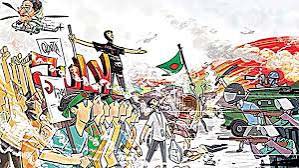

Before 5 August 2024 Bangladesh stood at a threshold. The July Uprising had shaken the political superstructure, toppling symbols of patron-client rule and forcing a reckoning with entrenched authority. It was a moment of rupture, when the energy of Gen Z and the broader citizenry converged to demand systemic change. Marx would have called this a revolt against the visible façade; the statues, the leaders, the laws. But he would also have warned that unless the base ; the economic system, the networks of corruption, the structures of ownership — was rewritten, the new superstructure would eventually behave like the old one.
Two years later, Mirza Fakhrul Islam Alamgir’s words echo that warning. Speaking recently, he admitted with “deep pain” that “nothing has changed. Those who took bribes before are still finding ways to do so, and those who obstructed good initiatives are still standing in their way. Only their appearances have changed… they have now become the biggest July fighters.” His statement captures the paradox of the present: reform initiatives working hard to steer the administration, yet corruption and inertia moving in their own way, untouched at the base. It is a sobering reminder that revolutions against the superstructure do not automatically translate into transformations of the base.
This is not a uniquely Bangladeshi dilemma. Across the border, India’s “cockroach” protests — sparked by an insult to unemployed youth — grew into a satirical movement that led to the resignation of an Education Minister after weeks of demonstrations. Gen Z in the Global South has proven itself adept at hacking the superstructure, deleting “admins” of governments with digital mobilization and street protests. Yet the deeper question remains: can they rewrite the source code of the economy, the institutions, and the rules of wealth creation?
Looking back to August 2024, Bangladesh was defined by fragility. Inflation was biting, foreign reserves were under pressure, and the garment sector remained the dominant but vulnerable engine of exports. The uprising was a cry against political patronage, but beneath it lay economic grievances: youth unemployment, cronyism, and the sense that meritocracy was being suffocated. The promise was that a new generation would not only change the faces in power but also re-engineer the system itself.
Today, in August 2026, the picture is more complex. On one hand, there are undeniable signs of effort: negotiations on Preferential Trade Agreements (PTA) with Indonesia and other partners, attempts to stabilize energy imports, and initiatives to prepare for LDC graduation. On the other hand, the structural base remains largely intact. The economy still leans heavily on RMG exports, foreign debt obligations continue to weigh, and corruption persists in the arteries of administration. Fakhrul’s lament is not just political rhetoric; it is a reflection of the stubborn resilience of the base.
Marx’s insight helps us see why this matters. Changing the superstructure — the leaders, the laws, the slogans — can create temporary relief, but unless the base is transformed, exploitation reasserts itself. In Bangladesh, the base is defined by cheap labor, fragile banking institutions, and dependence on external markets. Unless these foundations are rewritten, the new superstructure risks becoming a fresh face on an old operating system.
The youth imperative remains central. Bangladesh’s demographic dividend is both an opportunity and a risk. In 2024, Gen Z was the shock force of the uprising. In 2026, they are entering institutions, ministries, and political parties. The challenge is whether they can avoid becoming a new elite, disconnected from the grassroots. History shows that revolutionary vanguards often morph into ruling classes. The test for Bangladesh’s youth leaders is whether they can remain rooted, translating protest energy into policy reform: banking transparency, labor rights in the garment sector, and dismantling colonial-era policing laws.
The regional resonance is instructive. India’s cockroach protests show how satire and digital mobilization can destabilize entrenched power. But they also reveal the limits of superstructure change. A minister resigned, yet the systemic issues of exam leaks, unemployment, and bureaucratic inertia remain. Across the Global South, youth movements are brilliant at forcing accountability in the superstructure, but the base — the economic code — resists rewriting. Bangladesh’s challenge is to break that cycle.
As the nation prepares for LDC graduation, the stakes are high. Graduation is not just a statistical milestone; it is a structural shift. Preferential access to markets will fade, and Bangladesh must secure new reciprocal trade arrangements. This requires more than slogans; it demands systemic reform. Local Currency Settlement frameworks, industrial diversification, and maritime connectivity are not abstract ideas — they are the tools to rewrite the base. Without them, the promise of the uprising risks becoming a temporary flush of elites, as Pareto once described, rather than a lasting transformation.
Neutral reflection requires acknowledging both sides. The hard work of state reform is visible, as Fakhrul himself conceded. Yet corruption’s persistence is undeniable. The July Uprising was real, the courage was undeniable, but the deeper system remains to be rewritten. The lesson from Marx, from Fakhrul’s lament, and from India’s cockroach protests is clear: revolutions against the superstructure must be followed by revolutions of the base. Otherwise, the operating system remains the same, and the new users eventually act like the old ones.
Bangladesh today stands in a liminal space — between the memory of uprising and the mandate of reform. The “Delete” key was pressed in 2024. The interim period was the “Loading” screen. The 2026 election cycle is the “Save” button. Whether the nation saves a new system or simply saves a new face on the old system depends on whether the base is rewritten. That is the challenge of our time, and it is the measure by which history will judge this generation.
Punch Line ( Teaser ): “Two years after the July Uprising, Bangladesh stands between memory and mandate. Mirza Fakhrul warns corruption endures, while India’s ‘cockroach’ protests echo a wider Gen Z struggle across the Global South. The question remains: can we rewrite the system’s base, not just its face?”
Views: 2