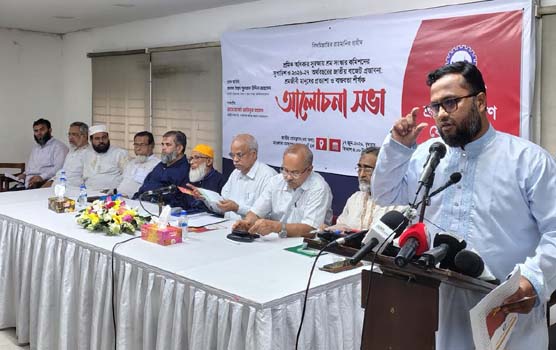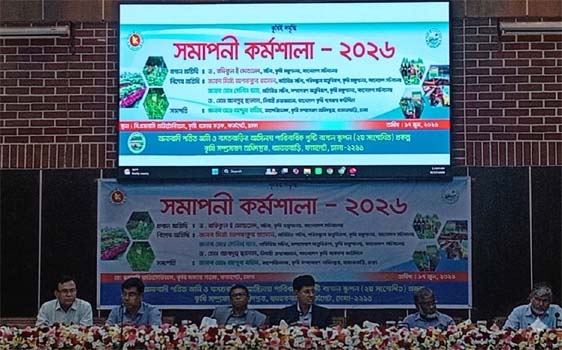

Rajiv Dey : A national-level concluding workshop was held to review and inform the activities of the ‘Family Nutrition Garden Establishment in Uncultivated Fallen Land and Homestead Yards (2nd Revised)’ project being implemented under the Department of Agricultural Extension. This workshop was successfully completed at 09:00 AM today, Wednesday, June 17, 2026, at the Bangladesh Agricultural Research Council (BARC) Auditorium, Farmgate, Dhaka.
The Honorable Secretary of the Ministry of Agriculture, Mr. Dr. Rafiqul Islam, was present as the chief guest in the workshop. The Director General of the Department of Agricultural Extension, Mr. Md. Abdur Rahim, presided over the program. Mr. Mirza Ashfaqur Rahman, Additional Secretary of the Planning Division of the Ministry of Agriculture, Mr. Md. Selim Khan, Additional Secretary of the Extension Division and Dr. Md. Abdullah Salad, Executive Chairman of the Bangladesh Agricultural Research Council (BARC) were present as special guests.
The workshop was attended by officials of various levels of DAEs from 492 upazilas of 64 districts of the country, farmer representatives and officials of related institutions and organizations including the Planning Commission and IMED.
The speakers at the workshop said that this project was taken up with the aim of ensuring the food and nutrition security of the country and ensuring the best use of uncultivated land. Currently, the project is being implemented very successfully in 492 upazilas of 64 districts of the country. It is making a significant contribution to meeting the nutritional needs of the country by bringing the uncultivated fallow lands lying around the homes in the project area under cultivation. A total of 4,99,900 family nutrition gardens have been established under the project so far. In addition, a total of 53,7022 exhibitions of vegetable and spice crops have been successfully established, including 7,380 exhibitions of raw vegetables cultivation in damp land, 20,188 exhibitions of ginger/turmeric cultivation in bags in shaded places or homesteads, 984 exhibitions of nutritional gardens in the backyards of educational institutions or suitable vacant spaces, 46,707 exhibitions of chili cultivation and 49,8485 exhibitions of family nutritional gardens maintenance and restoration. 142 community-based vermicompost (earthworm fertilizer) production pits have already been established for environmental conservation, soil health protection and employment generation.
Highlighting the achievements of the project, the speakers further said that so far 4,959.06 hectares of uncultivated land have been brought under cultivation through this project. As a result of various activities such as exhibitions, training and yard meetings, an additional 1,800 hectares of uncultivated land have been brought under cultivation through motivation of farmers. Due to the project, a total of 6,21,752.75 million tons of vegetables and ginger-turmeric have been produced, with an estimated financial value of about 2,181 crore 16 lakh 40 thousand 270 taka. In addition, a total of 21,426.372 million tons of biofertilizer and earthworms have been produced, with an estimated market value of about 33 crore 31 lakh 10 thousand 640 taka. The total financial achievement of the project at the current market price through the total crops and fertilizers produced stands at about 2,214 crore 47 lakh 50 thousand 910 taka.
Chief guest Dr. Rafiqul Islam said in his speech, “Sustainable development of agriculture is possible only through adopting and implementing age-appropriate plans. The lessons learned and successful models from this project will be expanded to other regions of the country in the future, which will play a far-reaching role in the country’s agricultural development, nutritional security and rural economic development.” He expressed hope that the people of the project area will retain the practical knowledge they have gained about nutrition in the long term and the Department of Agricultural Extension will maintain overall surveillance in this regard.
The participation of women in the workshop was mentioned as one of the major successes of this project. Through family nutrition gardens and vermicompost production, rural women are getting additional income opportunities besides fulfilling the nutritional needs of the family, which is playing a helpful role in increasing their economic empowerment and social status. The speakers proposed to adopt a future shadow project on the model of this project to meet the nutritional deficit of the country in order to maintain the continuity of this success.
Views: 5