
Rajiv Dey :
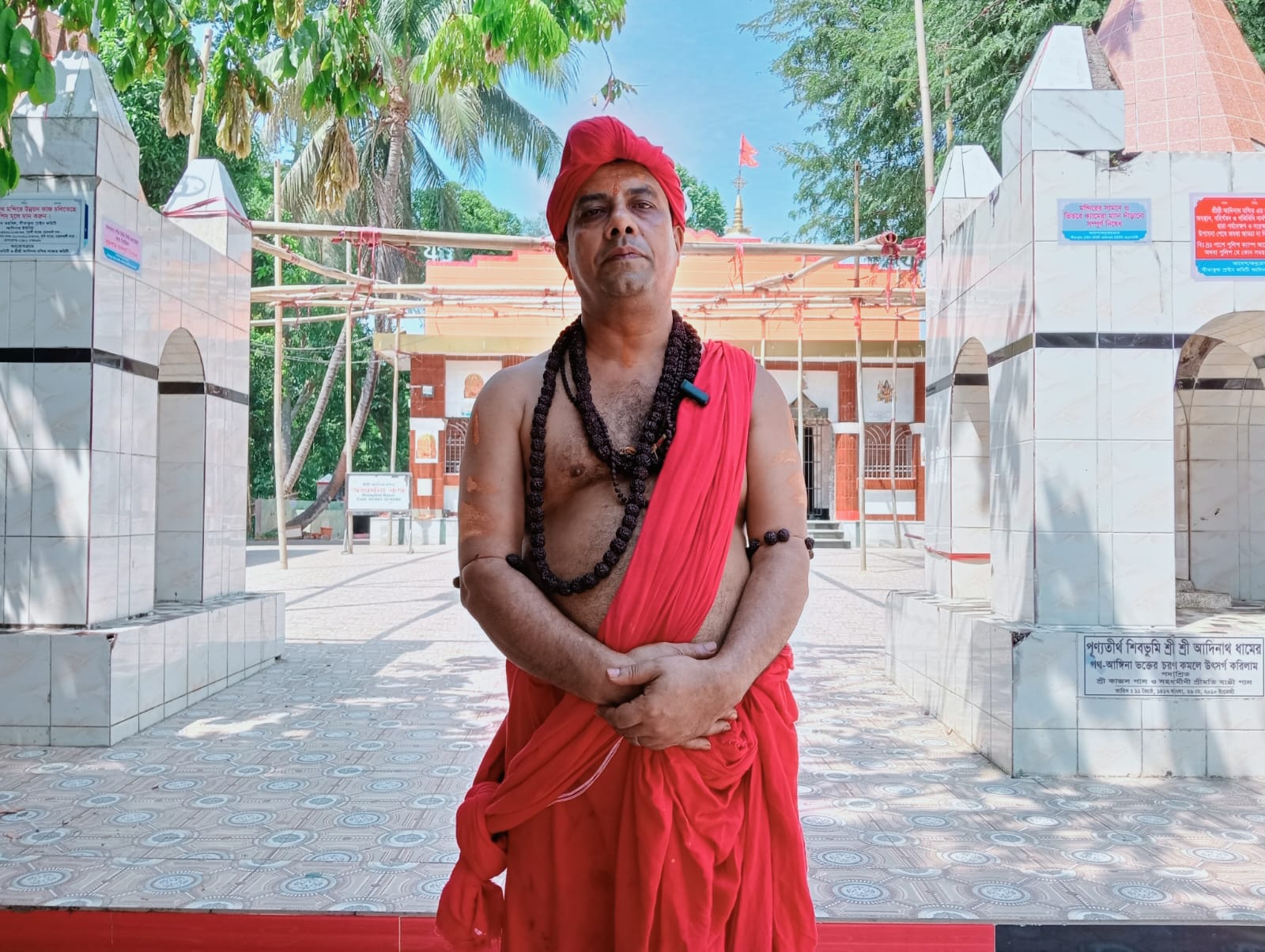
The traditional Adinath Temple is one of the pilgrimage sites for the followers of traditional religions located on Maheshkhali Island in Cox’s Bazar district. Recently, the head priest of the temple, Rahul Chakraborty, gave a detailed talk about the mythological origin and historical background of this temple in an interview on Sunday, May 10, 2026. Rahul Chakraborty, who has been serving Baba for 25 years, highlighted the history of the evolution of the temple from the Treta Yuga to the present time.
Rahul Chakraborty said that the history of the Adinath Temple began in the Treta Yuga. Ravana, the king of Lanka, prayed to Mahadev to please him and ask him how he could win the war with Rama. Mahadev then advised him to take the original Shivalinga (Adinath) from Kailash to Lanka and worship it royally. However, there was a condition that this Shivalinga should not be touched on the ground anywhere before reaching Lanka. Wherever it is touched, it will be permanently established there.
When Ravana was passing over the Mainak mountain, he felt the urge to urinate intensely. Seeing that he could not do so with the holy Shivalinga in his hand, he requested a monk to hold it for a while. But after a long time, the monk left the Shivalinga on the ground and completed the worship and left. As a result, Adinath was permanently established there as per the condition. Ravana returned and despite his hundred attempts, he could not move the Shivalinga.
The chief priest said that about 700-750 years ago, when a settlement was established in this region, a Muslim landlord named Nur Mohammad Sikdar lived here. One day, while hunting, he saw a cow miraculously pouring milk onto the Adinath Shivalinga. The landlord took the Shivalinga to his palace out of curiosity. When a shepherd went to lend him a sword, sparks of blood and fire started coming out of the Shivalinga.
Later, the landlord was instructed in a dream that the Shivalinga should be returned to its original place and worshipped. Otherwise, he would be in misfortune. Although the landlord did not pay any attention at first, he became afraid when various calamities and dangers arose in his area. Later, he handed over the Shivalinga to the monk (Gorakshanath) he had seen in his dream and arranged for worship.
Rahul Chakraborty mentioned that the island was named ‘Maheshkhali’ after Maheshwar (Adinath) and the name of the monk (Gorakshanath) who worshipped it was ‘Gorakhatha’, the name of the Maheshkhali Sadar area. The descendants of Muslim landlord Nur Mohammad Sikdar still live in the Gorakghata area, which is a unique example of communal harmony.
The octagonal Durga idol located in the temple premises was installed by the king of Nepal about 750 years ago. In Maheshkhali, idol worship is not usually done, but Ghat worship is done. However, this octagonal Durga is the main worshipped goddess here. Besides, there are two ponds behind the temple, the water of which remains sweet and drinkable for 12 months despite being in the middle of the salty sea, which is a wonderful fact.
Finally, Chief Priest Rahul Chakraborty reiterated the importance of this temple and its reputation and heritage around the world.
Views: 3