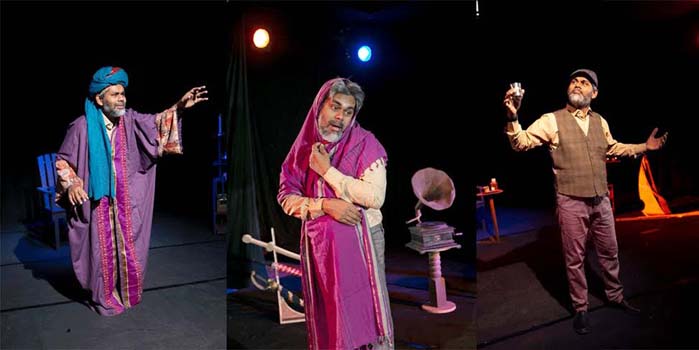

Rezaul Karim Reza : There are few challenges in theatre as daunting and exhilarating as standing alone on stage. For Md. Ershad Hasan, a veteran of over two decades in theatre, that challenge comes alive in Vasane Ujan, Vivekananda Theatre’s milestone 25th production. Adapted from Dostoevsky’s beloved short story The Gentle Spirit by Apurba Kumar Kundu and directed by Subhasish Datta Tanmoy, the solo performance promises an intimate exploration of human emotions, inner conflicts, and the subtle question of goodness in a complex world. Hasan, speaking exclusively to Present Times, reflects on the journey of embodying a character whose psychology is as intricate as Dostoevsky’s prose.
The Allure of Solo Performance
Asked why he chose a solo role, Hasan explains, “From the very beginning, it was the story, the character’s psychology, and its depth that drew me in. After discussing it with the director and playwright, I found the courage to take on this solo challenge.”
The challenge of translating Dostoevsky’s layered psychological universe to the stage is not lost on him. “Dostoevsky’s psychology is multidimensional. Bringing his writing to the stage requires extensive preparation. Ironically, that challenge is what inspired me the most,” Hasan says.
Carrying the Weight of the Stage Alone
Performing alone requires carrying every aspect of the story-character, energy, movement, and voice. Hasan admits, “Even a momentary lapse in focus can disrupt the story’s continuity.”
To prepare, he immersed himself in deep reading, character analysis, and rigorous practice of body language and vocal modulation. “I also researched psychology to bring authenticity to the performance,” he adds.
Personal Resonance and Reflection
What strikes Hasan most about the play is its power for self-reflection. “The inner questions of the character made me examine my own life in a new light,” he shares.
With Vivekananda Theatre celebrating its 25th production, the pressure was palpable. “It is a milestone for the troupe, and I felt the responsibility to uphold its standard by giving my absolute best,” he explains.
Collaborating with Creatives
Hasan praises director Subhasish Datta Tanmoy as “hardworking, intelligent, and very actor-friendly,” adding that the director gave him complete freedom in shaping the character. Likewise, he describes Kundu’s adaptation as a brilliant contemporary translation of Dostoevsky’s work that “helped me inhabit the character fully.”
The Power of Solo Theatre
For Hasan, solo theatre offers an unparalleled connection with the audience. “It brings them intimately close to the character. They experience firsthand who this person is, what they think, and why they behave as they do,” he explains.
To aspiring theatre artists, Hasan offers a succinct philosophy: “Practice regularly, read continuously, and maintain self-respect. Theatre is more than acting- it’s a way of life.”
A Message for the Audience
Hasan hopes the performance will provoke reflection. “The play asks whether a person can truly remain good until the end. Audiences will confront this question in their own way and find their own answers,” he says.
His ultimate wish is simple yet profound: “I hope audiences think, feel, and engage in discussion. If they leave the theatre reflecting on their own lives, I will consider it a success.”
Views: 10